Team Lead Management for Brokerages: Stop Losing Leads Between Agents
By Adam Kalimi · Published · 4 min read
Every brokerage has the same quiet leak: leads that belong to nobody. A sign call gets scribbled on a sticky note. An open-house list sits in one agent's inbox. A farm area's owner data lives in a spreadsheet only the head broker can find. None of these leads were lost to a competitor — they were lost to ambiguity about whose job they were.
Team lead management is the discipline of making every lead somebody's responsibility, visibly, with a deadline. This guide covers the model we've seen work for small brokerages and teams — and how WhoseTitle implements it.
The three failure modes of team lead flow
1. The hoarder problem. Assign leads permanently and top producers sit on more than they can work. A lead assigned six weeks ago with no contact isn't "being worked" — it's being buried, and reassigning it by hand requires an awkward conversation nobody initiates.
2. The free-for-all problem. Keep leads in a shared list with no assignment and the opposite happens: two agents call the same owner in one week (embarrassing), while fifty other owners get called by nobody (invisible).
3. The black-box problem. The head broker can't see per-agent follow-through — how many contacts each broker made, which leads stalled at which stage — so coaching happens on vibes and production numbers arrive too late to fix anything.
The model that works: a pond, not a pile
The structure that solves all three is old-school sales-floor wisdom with a modern name — a lead pond:
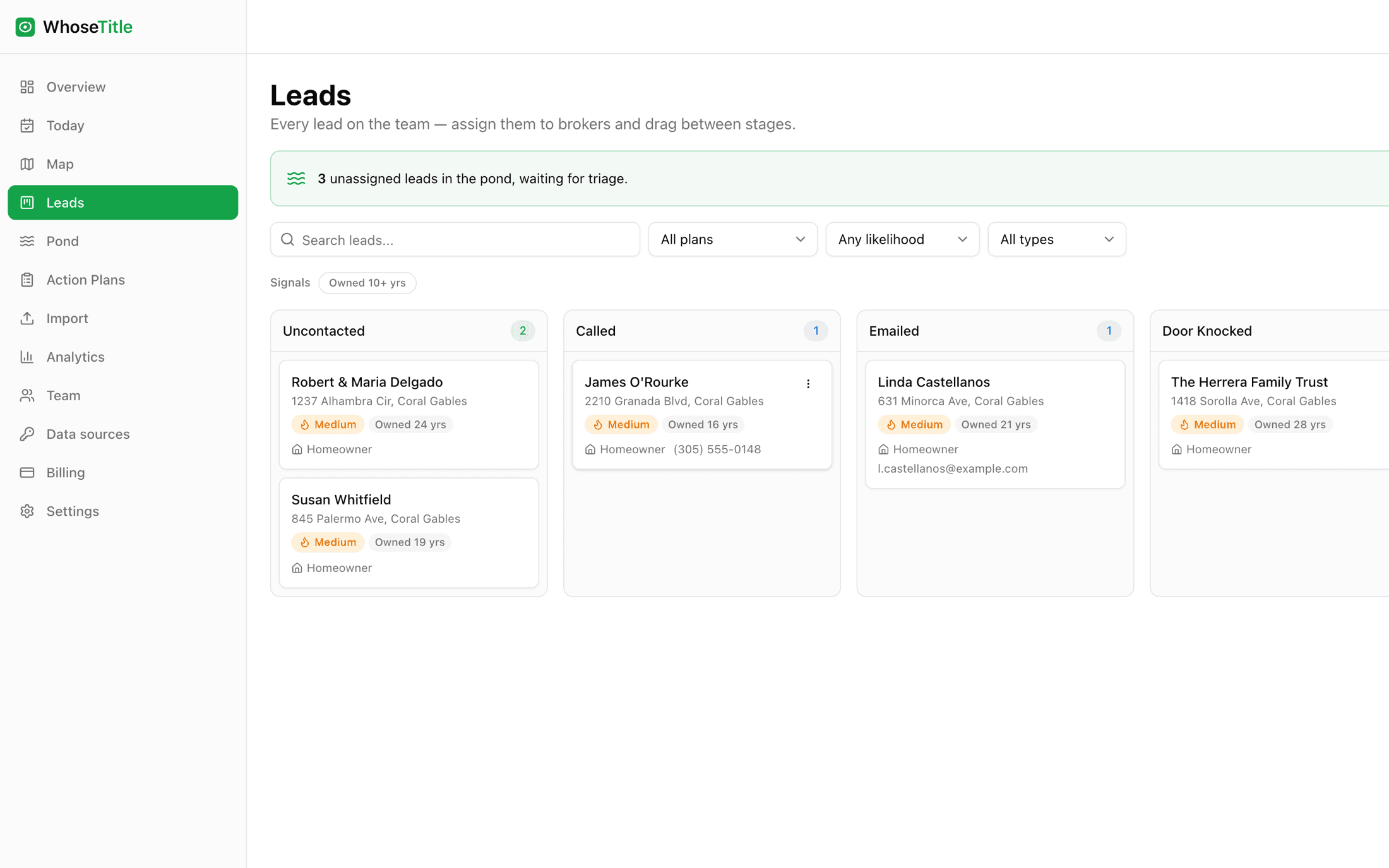
- Unassigned leads live in a shared pond every team member can see. New discovery pulls, imports, and returned leads land there. Nothing is invisible.
- Assignment is explicit. The head broker assigns from the pond (or brokers grab, if you allow it). One owner, one responsible agent — no double calls.
- Neglect sends leads back automatically. The teeth of the system: if an assigned lead sees no activity for a set number of days, it returns to the pond for someone else to work. Nobody hoards what they don't touch. In WhoseTitle this is auto re-pond — you pick the day threshold, and untouched leads quietly recirculate.
- Every lead carries its history. Whoever picks a lead up sees prior calls, notes, and statuses, so a recirculated lead isn't a cold start.
Making follow-up inspectable, not aspirational
Assignment answers whose job is it. The second half is is the job happening — and that requires two things:
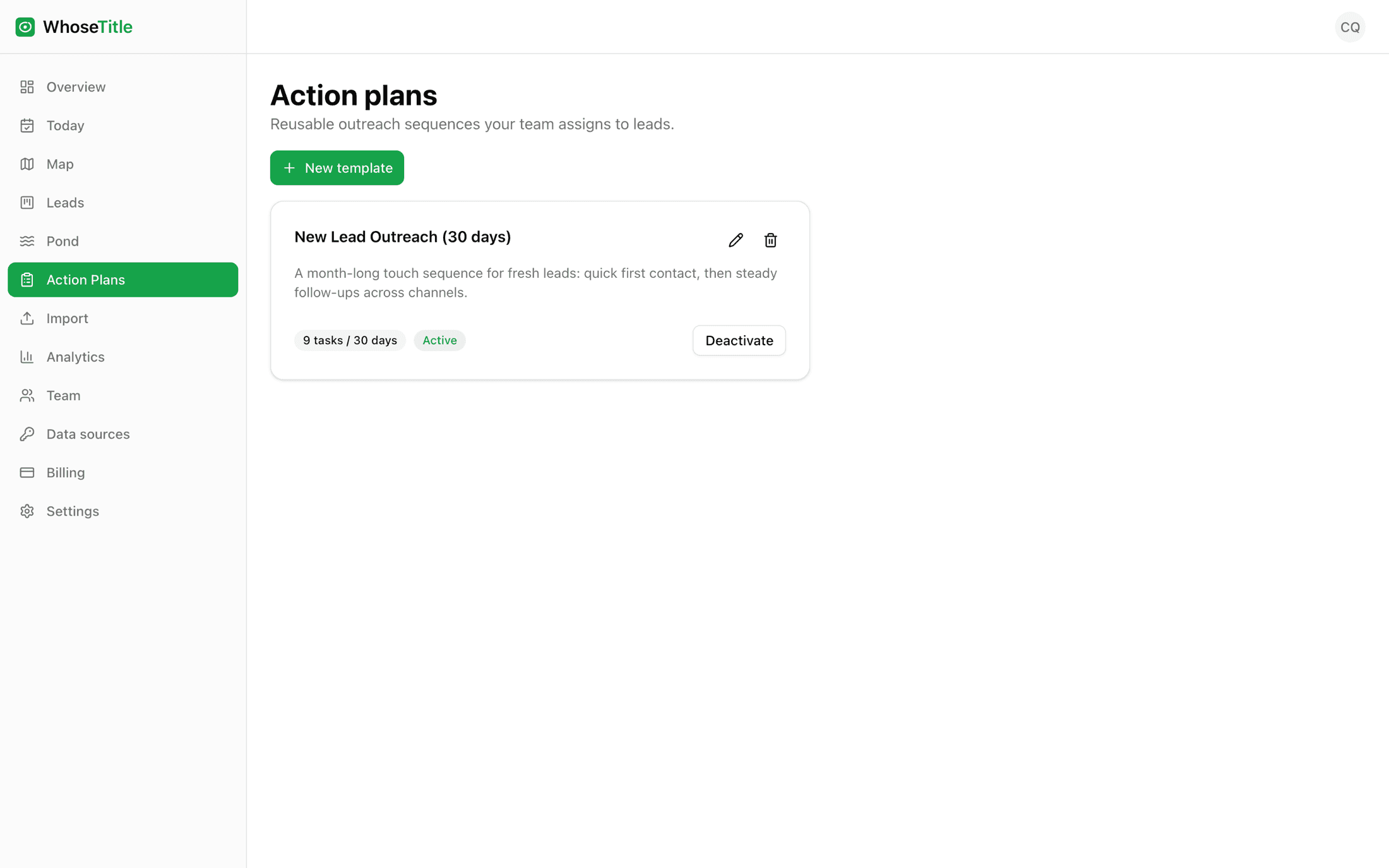
Action plans instead of intentions. When a broker takes a lead, attaching a follow-up sequence — day 1 call, day 2 email, day 5 door knock, and so on — turns "stay on top of it" into dated tasks on that broker's today list. Every WhoseTitle team starts with a 30-day outreach plan built in; head brokers can define their own sequences for the whole team.
Per-agent analytics. The head broker sees conversion by stage and by person: who's contacting their assignments, where each broker's leads stall, who converts door knocks but not calls. That turns the Monday meeting from "everyone make more calls" into "your leads die between second and third contact — let's fix that step."
What this looks like day-to-day
- Monday: the head broker draws the week's farm area on the map, pulls the owners from free county records, and drops 120 leads into the pond.
- Brokers get assigned 30 each; an action plan attaches automatically; today lists populate.
- Wednesday: a broker skip-traces her hottest 10 owners on the team's own data-provider key — the connection is shared team-wide, but only the head broker can see or change the key.
- Next Monday: eight untouched leads re-ponded overnight; the dashboard shows one broker's stall pattern; leads get rebalanced in five minutes, not renegotiated for a week.
What it costs to run this
Team tooling is where most CRMs get expensive, because they charge full per-user rates for every agent. WhoseTitle's pricing is built for the broker-plus-team shape instead: $45/month includes the head broker's seat, and each additional broker is $20/month — prorated automatically as people join or leave. A five-person team runs $125/month, with the county data free and skip tracing at your provider's wholesale rate. Compare that to per-seat CRMs at $69 per user and the math favors keeping the whole team in one system instead of rationing seats.
The pond, assignment, auto re-pond, action plans, and per-broker analytics are all included — because a team CRM where the accountability features are the upsell is a team CRM that leaks leads.
Turn any neighborhood into a lead list
Draw an area on the map, pull every owner inside it, and work them through action plans — that's WhoseTitle.
Keep reading
- 1031 Exchange in California: Rules, the Clawback, and Form 3840
California 1031 exchange rules: how the state taxes deferred gains, the out-of-state clawback, annual Form 3840 filing, and the real-estate withholding exemption.
- 1031 Exchange in Florida: Rules, Taxes, and Why It's Popular
Florida 1031 exchange rules: no state income tax on the gain, but doc stamps and note taxes still apply — plus the clawback trap when exchanging in from other states.
- Can You 1031 Exchange Into a Primary Residence? The 5-Year Rule
How a 1031 exchange interacts with your primary residence: converting a replacement property into your home, the Section 121 exclusion, and the 5-year rule.