Local Business Leads: Map Every Business in Your Territory
By Adam Kalimi · Published · 3 min read
Residential agents aren't the only people who prospect by geography. Commercial brokers farm retail corridors. Insurance agents, payment processors, sign shops, and marketing agencies all sell to "every business on Main Street." Yet the tooling for local B2B prospecting is strangely bad: purchased business lists go stale in months, directory sites bury data behind exports, and most CRMs have no idea where anything is.
The map-first approach fixes this: draw the territory, pull every business inside it, and work the list like a pipeline instead of a phone book.
Why geography beats industry lists for local B2B
A bought list of "restaurants in the metro" gives you a spreadsheet sorted by nothing you care about. Working a territory gives you three compounding advantages:
- Route density. Twenty conversations on one corridor beat twenty scattered across a county. In-person drop-ins — still the highest-converting move in local B2B — only work when your prospects are walkable.
- Local proof. "We work with three businesses on this block" is the strongest opener in local sales. You can only say it if you sell block by block.
- Freshness. Live map data reflects businesses as they exist today — the new nail salon that opened last quarter is exactly the prospect no stale purchased list contains, and new businesses buy services.
The workflow in WhoseTitle
- Draw the territory. A freehand lasso around the corridor, retail strip, or industrial park — not a ZIP code, the actual blocks you can cover.
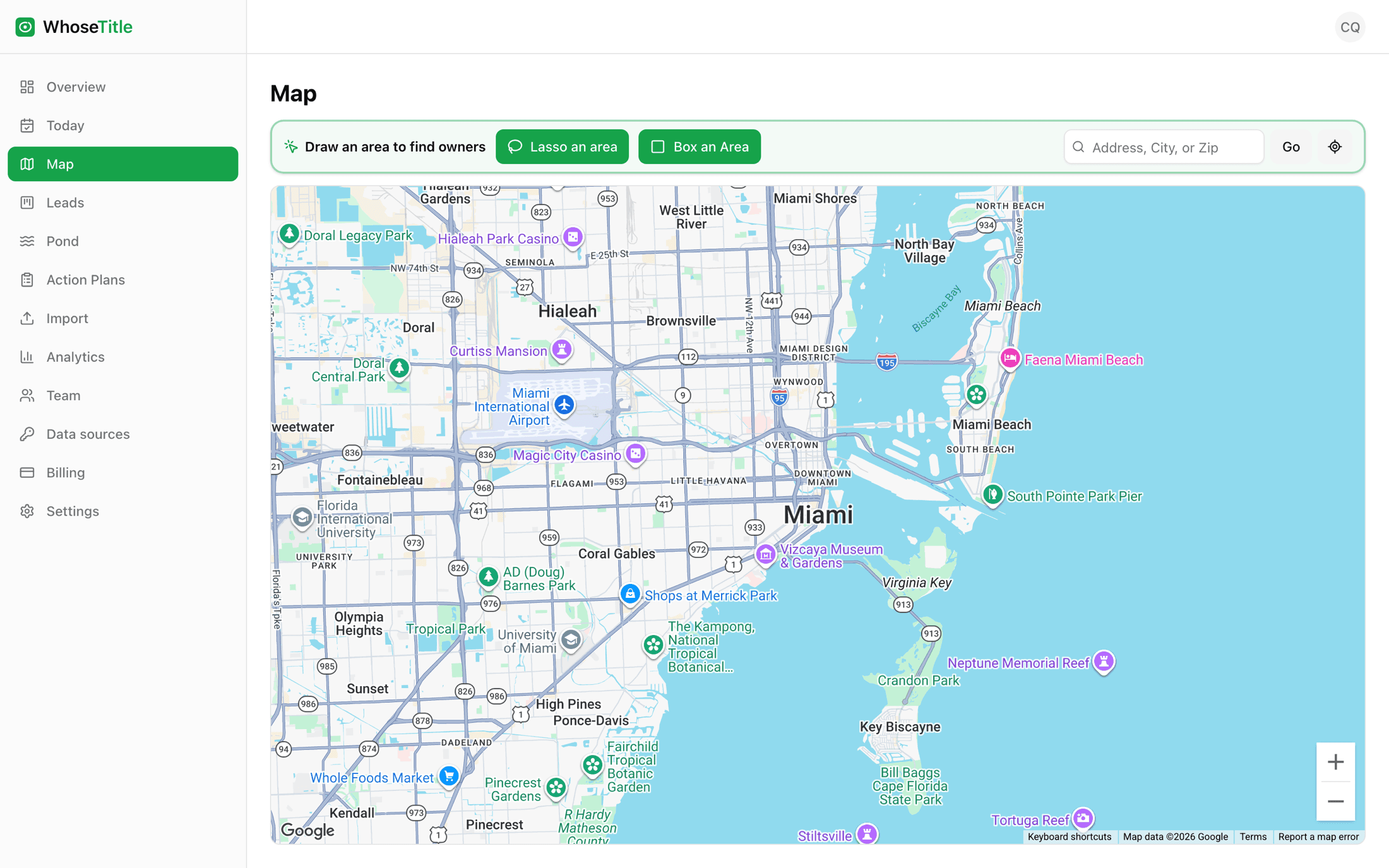 2. Pull the businesses. Business discovery runs on Google's live Places data through your own API key — names, categories, addresses, phone numbers, straight from the source that's freshest. (Google's monthly free usage tier covers typical prospecting volume, and you can try it on the homepage demo without an account.)
3. Save to the pipeline. Each business becomes a lead on your board with a map pin. Statuses track the journey — called, visited, follow-up, converted — and action plans put the day-2 follow-up on your calendar automatically.
4. Split territories across the team. The lead pond holds the unassigned pool; each rep owns their corridor; untouched leads recirculate automatically instead of dying in someone's forgotten tab.
5. Mix in property intelligence. This is the angle no B2B list tool has: the same map pulls property owner records. Commercial agents can see the business and research the building — a tenant conversation and a landlord conversation from one draw.
2. Pull the businesses. Business discovery runs on Google's live Places data through your own API key — names, categories, addresses, phone numbers, straight from the source that's freshest. (Google's monthly free usage tier covers typical prospecting volume, and you can try it on the homepage demo without an account.)
3. Save to the pipeline. Each business becomes a lead on your board with a map pin. Statuses track the journey — called, visited, follow-up, converted — and action plans put the day-2 follow-up on your calendar automatically.
4. Split territories across the team. The lead pond holds the unassigned pool; each rep owns their corridor; untouched leads recirculate automatically instead of dying in someone's forgotten tab.
5. Mix in property intelligence. This is the angle no B2B list tool has: the same map pulls property owner records. Commercial agents can see the business and research the building — a tenant conversation and a landlord conversation from one draw.
Who uses this
- Commercial and mixed-use agents canvassing corridors for listings, tenant reps, or owner-users.
- Local service B2B — insurance, payments, telecom, waste, marketing — anyone whose rep owns a geographic patch.
- Franchise and site-selection scouts mapping competitor density and open slots in a submarket.
- Residential agents with a commercial side hustle — the businesses on the strip by your farm area know every homeowner on it. Business relationships feed residential farming.
What it costs
The standard tools for this are either enterprise sales-intelligence platforms (hundreds per month, national data you don't need) or one-off list purchases that decay immediately. WhoseTitle is $45/month with your seat included and $20 per teammate; business data runs on your own Google key at Google's rates (typically free at prospecting volume), and the CRM, map, action plans, and team tools are all in the base price. Draw the territory on the homepage demo first — no account needed — and see what's actually on your Main Street.
Turn any neighborhood into a lead list
Draw an area on the map, pull every owner inside it, and work them through action plans — that's WhoseTitle.
Keep reading
- Bring Your Own Data: Why Your CRM Shouldn't Mark Up Property Records
How bring-your-own-key works in real estate lead gen: connect your own BatchData or idiCORE account and pay wholesale data rates — no CRM markup.
- Wholesaling Lead Generation: Build Off-Market Lists Without List Fees
How wholesalers and investors build off-market lead lists from free county records — tenure, sale history, and skip tracing at wholesale rates.
- Free Property Owner Data: How to Pull It by County in Florida
Get property owner names, sale history, and equity signals free from public county records — how it works, which Florida counties are covered, and the limits.